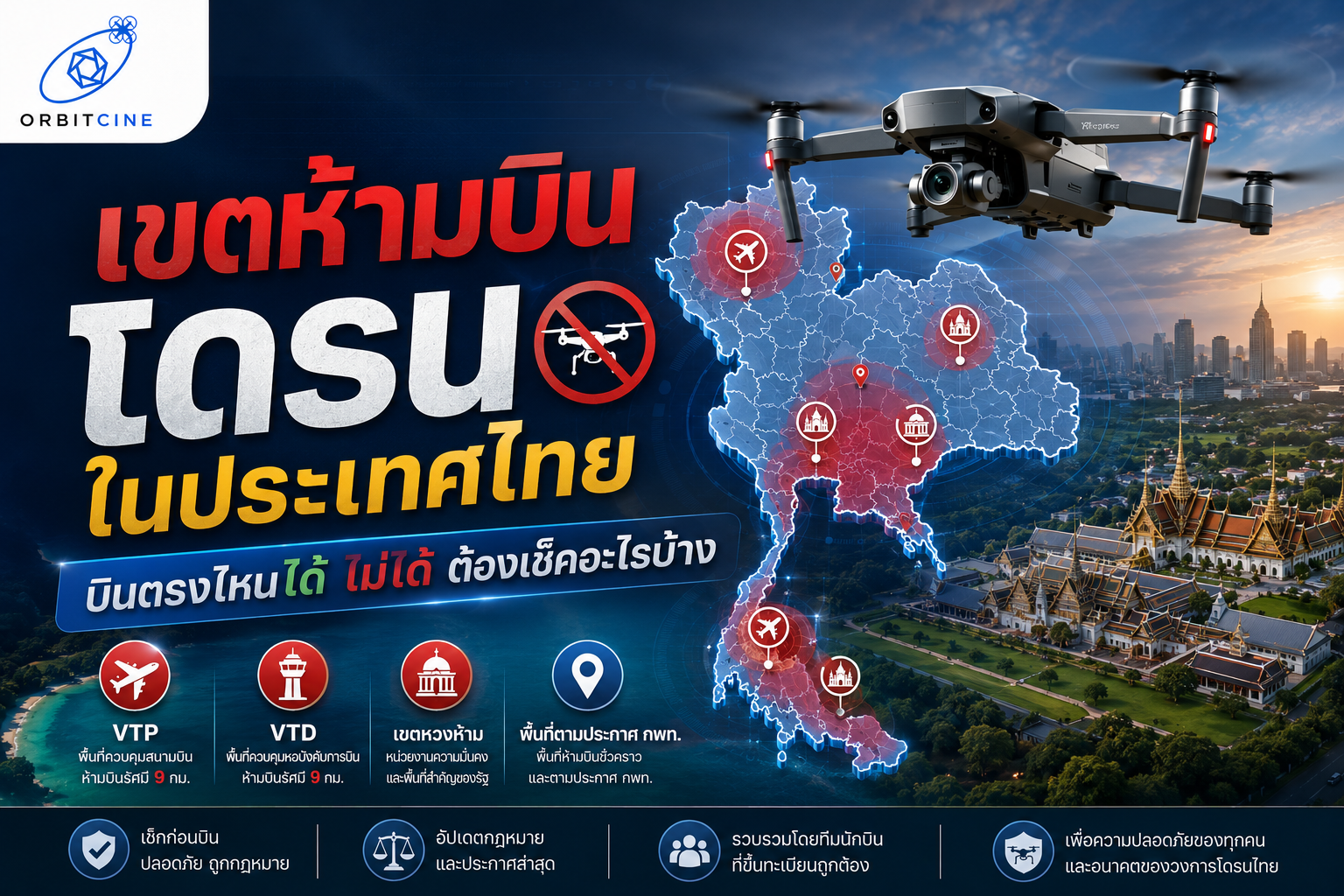
Quick answer Drone no-fly areas in Thailand fall into 4 main groups: a 9 km radius around airports · prohibited (VTP), restricted (VTR) and danger (VTD) areas published in CAAT's AIP · government sites, state agencies and hospitals · and temporary no-fly areas announced by CAAT. Check the coordinates before every flight with ourprovince-by-province no-fly zone checker
Before every take-off, the first question a drone pilot must answer is “Can I fly here?” Straying into a no-fly zone without realizing it carries legal penalties and puts other aircraft at risk. This article summarizes all of Thailand's drone no-fly zones and how to check an area before heading out — for pilots who fly themselves and for anyone about to hire an aerial photography team.
Not sure if your site can be flown?
ORBITCINE's registered pilots check the area and obtain permission before the job.
What are drone no-fly areas?
A no-fly zone is an area where the law and regulators prohibit or restrict unmanned aircraft, for flight safety, national security and the privacy of important sites. Every drone pilot — hobbyist or commercial — is legally responsible for checking the area before every flight.
A common beginner misconception is “if there's no sign, I can fly.” In reality, most no-fly zones have no signs on the ground; they're defined by coordinates and radii in official announcements. So the check has to be done on a map or a checking tool before you travel to the site — not once you get there.
How many types of drone no-fly areas are there in Thailand?
Under CAAT's drone flight conditions and the AIP Thailand, areas where drone flights are prohibited or restricted fall into 4 main groups, as shown in this table.
| Zone type | Extent | Example areas |
|---|---|---|
| Around airports | No flying within 9 km (5 nautical miles) of an airport or temporary aircraft landing site, unless permitted by the airport owner or operator | Commercial airports, military airfields and temporary landing sites |
| VTP · VTR · VTD — prohibited, restricted and danger areas | Boundaries and altitudes as published in CAAT's AIP Thailand | Military areas, bases, royal residence areas and military flight training areas |
| Government sites | No flying in, unless permitted by the agency that owns the area | Government sites, state agencies and hospitals |
| Areas announced by CAAT | Announced from time to time — both permanent and temporary | Areas during royal ceremonies, major state events and special operations |
Group 4 needs the most care: temporary no-fly areas can be announced at any time and take effect immediately. Pilots shouldn't rely on information from previous flights — check again before every job.
How close to an airport can you fly?
CAAT conditions prohibit flying a drone within 9 km (5 nautical miles) of an airport or temporary aircraft landing site, unless permitted by the airport owner or operator. That's a wider radius than many people think. For example, many urban areas of Bangkok and its surrounding provinces fall within it, even where you can't see the airport at all.
If you really need to fly in such an area, you must apply in advance to the airport owner or operator, stating the coordinates, altitude, date, time and purpose of the flight. The process takes time, so plan at least several weeks ahead for jobs in controlled areas.
Laws and regulators
Drone flying in Thailand falls under the Air Navigation Act and is regulated by the Civil Aviation Authority of Thailand (CAAT) for flights and pilots, while the NBTC oversees the registration of the aircraft and the radio frequencies used to control it.
Pilots flying commercially or using drones that meet the criteria in the announcements must register with both agencies before flying. Read the step-by-step details in our article Registering a drone with the NBTC and CAAT, step by step Announcements and conditions are updated from time to time, so check the latest information on the CAAT website directly before every flight.
Interested in hiring aerial photography or video?
Properly registered pilots with experience in advertising, real estate and events.
How to check drone no-fly areas before flying
The fastest and safest way is to check a source that brings the official announcements together in one place. ORBITCINE built a province-by-province drone no-fly zone finder that's free to use with no sign-up, covers every province in Thailand and opens instantly on your phone on site.
Besides checking the area, follow these practices every time:
- Check your flight coordinates with the tool or the latest announcements — never use old information
- Prepare a flight plan and pre-flight checklist in writing, especially for client jobs
- Keep the drone within visual line of sight (VLOS) and below the legal altitude limit
- Avoid flying over crowds or densely populated areas, even outside no-fly zones
- Always carry your drone registration documents and license in case officials ask to see them
What are the penalties for flying into a drone no-fly area?
Flying a drone into a no-fly zone without permission is an offense under the Air Navigation Act B.E. 2497 (1954) and related regulations, punishable by up to 1 year in prison, a fine of up to 40,000 baht, or both. In security zones, officials can also use counter-drone systems to stop a flight on the spot, without prior notice.
| Violation | Maximum penalty |
|---|---|
| Flying in a no-fly zone or restricted area without permission | up to 1 year in prison, a fine of up to 40,000 baht, or both. |
| Not registering as a remote pilot with CAAT | Up to 1 year in prison or a fine of up to 40,000 baht |
| Not registering the drone's radio equipment with NBTC | Up to 5 years in prison or a fine of up to 100,000 baht |
| Flying at night or above the 90-meter ceiling without permission | A fine of up to 40,000 baht |
| Flying in a way that invades other people's privacy | A fine of up to 40,000 baht |
What many people don't realize is that each of these penalties counts as a separate offense. A single flight that breaks several rules at once (an unregistered drone, flying in a restricted area, and flying above the altitude limit, for example) can add up to fines in the hundreds of thousands of baht. The rates above are the legal maximums; the court decides based on the circumstances and the actual damage caused.
Temporary drone no-fly areas: where people most often slip up
Besides the permanent no-fly zones that are always on the map, there are also temporary flight bans issued from time to time as situations arise. These are the most common reason pilots get caught, because an area that was open last month may be closed on the very day of your shoot.
A real example: in late July 2025, the Civil Aviation Authority of Thailand issued an urgent notice temporarily banning all types of drones nationwide due to the security situation on the Thai–Cambodian border. It then allowed agricultural drones to fly from 11 Aug 2025 and reopened flights for all types under conditions from 16 Aug 2025. Notices like this take effect immediately and cover areas where flying is normally allowed.
Latest status (Oct 2026): CAAT Announcement No. 16 (2026), issued on 25 June 2026, still bans drone flights in some districts of 7 provinces on the Thailand–Cambodia border: Ubon Ratchathani, Si Sa Ket, Surin, Buri Ram, Sa Kaeo, Chanthaburi and Trat. If your job is in one of these provinces, check the district list in the CAAT announcement and make sure there is no newer version before every flight.
Common triggers for temporary no-fly zones include royal visits and ceremonies, international summits, border security situations, search-and-rescue operations, and wildfire fighting involving aircraft. The rule of thumb: always check the latest notices on the day you fly, not when you planned the job a week earlier.
Frequently asked questions
How close to an airport can I fly a drone?
Controlled airspace around airports and control towers has a no-fly radius of 9 kilometers from the reference point. If you need to fly within this radius, you must always apply for permission from the responsible authority in advance.
What should I do if I'm not sure whether an area is a no-fly zone?
Start with the province-by-province no-fly zone checker. If you're still unsure, don't fly there, and ask the relevant authority directly. Flying first and dealing with the consequences later is far too risky.
What's the penalty for flying in a no-fly zone?
It's a legal offense, and the penalty depends on the nature of the violation and the type of area involved. Violations in security zones are treated far more seriously than in ordinary areas.
Do no-fly zones change often?
Permanent zones such as VTP and VTD rarely change, but CAAT can announce temporary no-fly areas at any time, effective immediately. That's why you need to check again before every flight.
Do I need to check no-fly zones when flying over my own land?
Yes. No-fly zones are defined by the airspace above an area, not by who owns the land. If your land falls within a controlled radius, flying there is still prohibited.
If I hire a drone team, who is responsible for checking no-fly zones?
A professional pilot team should check the location and handle any permits before the job. As the client, ask about this when you request a quote, so your shoot doesn't get shut down halfway through.
Summary
Thailand's drone no-fly zones fall into 4 main groups, and the no-fly radius around airports extends as far as 9 kilometers, covering far more ground than most people expect. Checking your coordinates before every flight is a step you can't skip—not just because of the law, but because it's the foundation of flying professionally. If you're about to hire a team, see what to check first: Do you need a permit to hire a drone team?
Need a properly registered pilot team?
ORBITCINE takes care of everything from site checks and flight permits to delivering the final work.
Related services
- Aerial photo and video services
- Drone service center: training, repairs, and sales
- Province-by-province no-fly zone checker
- Civil Aviation Authority of Thailand (CAAT) — caat.or.th (drone operating rules and announcements)
- Office of the NBTC — nbtc.go.th (radio equipment registration for drones)
- Air Navigation Act B.E. 2497 (1954) and related Ministry of Transport announcements
Still not sure? Want our team to take a look at your job?
Send us a message and tell us about your project. Our legally registered pilots will assess it and give you a free quote.
Legally registered pilots · Insured as required by law · Nationwide service