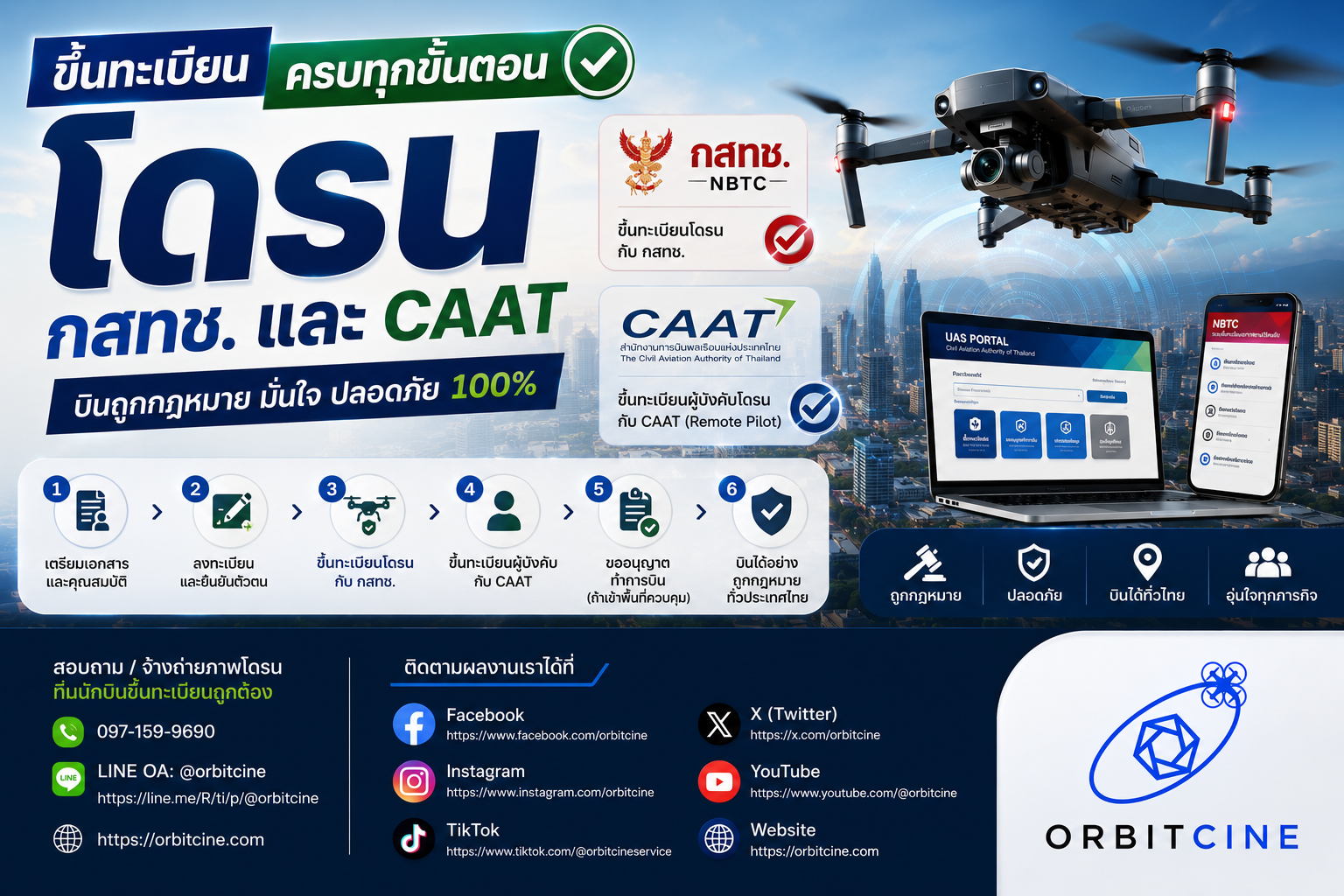
Quick answer Drone registration in Thailand involves 2 agencies: the NBTC for the aircraft and its radio frequencies, and CAAT for the remote pilot. Anyone flying commercially or using a drone that meets the criteria in the regulations must register with both before flying. Allow time for processing before taking on real jobs.
Before you can fly a drone legally in Thailand, the first step you can't skip is registration. Many people assume they can fly as soon as they buy a drone, but under the law a drone is an aircraft, and two separate agencies regulate it. This article sums up who you need to register with, which documents to prepare, and what you risk if you don't.
Want to become a drone pilot the right way?
ORBITCINE runs drone pilot courses that cover registration prep from the very start.
Why do you need to register a drone?
Under the Air Navigation Act, a drone is an unmanned aircraft, so owners and operators who meet the criteria in the regulations must register before flying. There are 3 main reasons: the safety of airspace shared with other aircraft, national security, and traceability if there's an accident or the drone is misused.
For anyone doing commercial photography, registration is also a matter of business credibility. Corporate clients and jobs in controlled areas often ask to see your documents before letting you work.
Which agencies do you register a drone with?
Thailand has two main agencies, each responsible for a different part, and most pilots need to register with both.
| Agency | Responsible for | Who must apply |
|---|---|---|
| Office of the NBTC | Registers the aircraft and the radio equipment and frequencies used for control and video transmission | Owners of drones that meet the criteria in the regulations |
| CAAT (Civil Aviation Authority of Thailand) | Registers remote pilots (people who operate or launch drones) and enforces flight rules | Commercial pilots, or drones that meet the conditions in CAAT regulations |
Put simply, NBTC registers the “drone” and CAAT registers the “pilot.” If you fly for commercial photo or video work, you need both in place before your first job.
What documents do you need to register a drone?
Document requirements may change with each agency's latest announcements, but in general you should have the following ready before you apply.
- The applicant's national ID card or other proof of identity
- Drone specifications: brand, model, serial number, weight, and operating frequencies
- Proof of purchase or ownership, such as a receipt or tax invoice
- Photos of the drone from the angles the agency specifies, including a clear shot of the serial number
- For commercial use, you may also need business registration documents or a company certificate
- Third-party liability insurance, where the regulations require it
A tip from experience: photograph the serial number and keep the receipt from the day you get your drone. These are the documents people most often can't find when it's time to apply.
Don't want to deal with the paperwork?
Hire a team that's already fully registered and ready to fly photo and video jobs right away.
Drone registration step by step
Both agencies handle registration mainly online. The overall steps are:
- Create a user account on each agency's system
- Fill in your personal details and the drone's specifications on the form
- Upload the required supporting documents and photos
- Wait for review and approval; how long this takes depends on how complete your documents are and how many applications are in the queue
- Receive your registration number or certificate, and keep it on hand to show if you're asked during a job
Because the forms and requirements are updated from time to time, check the latest steps on the CAAT website and the NBTC website directly every time before you start. Don't rely on old videos or posts.
Once your drone is registered, can you fly anywhere?
No. Registration is only the first requirement. Every flight must still follow CAAT's flight conditions, for example: no flying within 9 km of an airport or temporary aircraft landing site unless permitted by the airport owner or operator, no flying into prohibited, restricted or danger areas listed in the AIP Thailand, and flying only between sunrise and sunset.
If a job needs to fly differently from these conditions—for example, above 90 meters, after sunset or FPV through goggles—since 17 May 2026 the operator must obtain Specific Category approval from CAAT before flying. Applicants must complete a CAAT-recognized training course, and the drone must be registered with its registration number marked on the airframe. Details are summarized in Do you need a permit to hire a drone team?
Before every job, check your flight coordinates with ourprovince-by-province no-fly zone checker and read thesummary of the 4 types of drone no-fly areasas well, because CAAT can issue new temporary no-fly notices at any time, and an area you could fly last month may be off-limits on the day of the job.
A quick checklist before every takeoff
- NBTC and CAAT registrations haven't expired, and you carry proof to every job
- The flight point isn't within 9 km of an airport, or permission has been granted
- The flight point isn't in a VTP, VTR or VTD area, and there's no temporary no-fly notice that day
- Fly during daylight, and the remote pilot keeps the drone in visual sight at all times
What do you risk by not registering?
Besides breaking the law, the most obvious practical impact is this: if there's an accident or dispute during a job, not having valid registration puts both the pilot and the client at a disadvantage when it comes to establishing liability and claiming damages. Many insurance policies also don't cover flights that aren't legal.
For commercial jobs, there's also the risk of being shut down mid-job if officials inspect, which hurts both your costs and your credibility with the client.
Penalties for not registering: the actual figures under the law
The penalties for not registering are split between the two regulating agencies, and the NBTC side is harsher than most people think because it counts as possessing and using radio equipment without a license, not just a flying offense.
| Agency | What must be registered | Maximum penalty |
|---|---|---|
| NBTC | The drone and its control frequencies | Up to 5 years in prison or a fine of up to 100,000 baht |
| CAAT | Unmanned aircraft pilot | Up to 1 year in prison or a fine of up to 40,000 baht |
| Flying in a no-fly zone or restricted area without permission | Up to 1 year in prison or a fine of up to 40,000 baht | |
| Flying at night or above the 90-meter ceiling without permission | A fine of up to 40,000 baht | |
Each penalty counts separately, so a single flight that breaks several rules at once can add up to fines in the hundreds of thousands of baht. The rates above are the legal maximums; courts decide case by case based on the actual circumstances. Check the latest rates with the authorities directly before citing them, as the regulations are revised from time to time.
Frequently asked questions
Does every drone need to be registered?
It depends on the drone's weight and how it's used, under the conditions set out in the regulations. Very small toy drones may not meet the criteria, but most ordinary camera drones do. Check the latest criteria with NBTC and CAAT directly.
How long does registration take?
It depends on how complete your documents are and when you apply. Always leave plenty of lead time before you actually need to fly, and don't plan to take on a job assuming registration will be done in a few days.
Does registration need to be renewed?
Some types of registration are valid for a set period and must be renewed on schedule. Note the expiry date and renew in advance; don't wait until it expires and then reapply.
If I buy a used drone, do I need to register it again?
You need to update the owner details, because registration is tied to both the drone and its owner. Check the drone's registration history before you agree to buy.
Do I need to register to fly at home or indoors?
Flying inside an enclosed building generally isn't considered use of airspace, but the drone itself still has to be registered under NBTC rules if it meets the criteria. Check carefully first.
Do I also need a pilot license?
Registering with CAAT is separate from completing a training course, but a course helps you understand the flight rules and fly correctly. Course details: ORBITCINE Drone Service Center
Summary
Registering your drone with NBTC and CAAT is a basic step every pilot must complete before flying: NBTC covers the drone, and CAAT covers the remote pilot. Getting all your documents ready from the start will save a lot of processing time. And don't forget to check the no-fly zonesbefore every job. If you're just starting out and want to fly paid jobs, read on at Getting a drone license in Thailand: where do you start?
Need a pilot team that's ready to fly legally right away?
Every ORBITCINE pilot is fully registered, and we take jobs nationwide.
Related services
- Drone pilot courses and service center
- Aerial photo and video services
- Flight planning tool and preflight checklist
- Civil Aviation Authority of Thailand (CAAT) — caat.or.th (drone operating rules and announcements)
- Office of the NBTC — nbtc.go.th (radio equipment registration for drones)
- Air Navigation Act B.E. 2497 (1954) and related Ministry of Transport announcements
Still not sure? Want our team to take a look at your job?
Send us a message and tell us about your project. Our legally registered pilots will assess it and give you a free quote.
Legally registered pilots · Insured as required by law · Nationwide service